
Article
Article
Ceramic Fiber Paper for High Temperature Gaskets: Choosing the Right Solution
Learn how ceramic fiber paper performs as a high temperature gasket material — properties, applications, and how to choose the right grade.
Traci Aloi
Product & Market Manager of Paper/Engineered Fibers
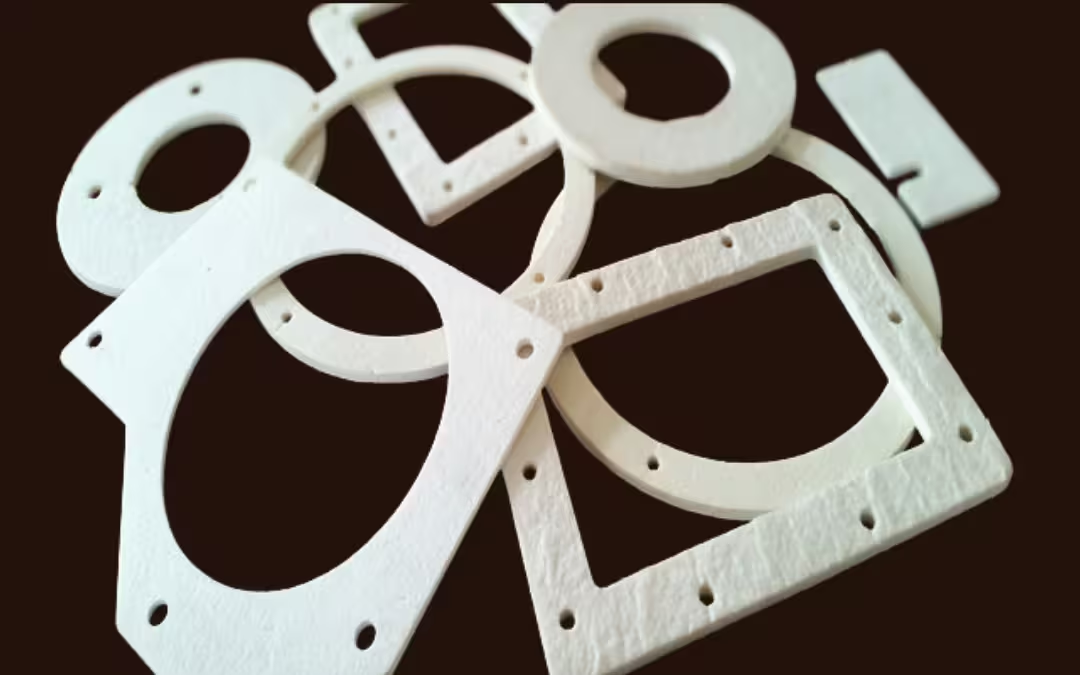
When standard gasket materials fail under extreme heat, ceramic fiber paper for high-temperature gaskets offers a lightweight, asbestos-free alternative that maintains performance well above 2,000°F. Here is what you need to know before specifying it.
Why standard gasket materials fall short in industrial applications
Industrial, petrochemical, metallurgical and glass processes run HOT. These processes are complex, demand a lot of energy and are difficult to maintain. Frequently operating well over 1000°C, most conventional gasket materials — rubber compounds, PTFE, and even fibrous glass — will fail. The result: increased energy consumption, poor production yields, unplanned shutdowns, and in some cases, safety incidents. This is why design and maintenance engineers in oil & gas, steel, power generation, automotive, appliance and aerospace specify high temperature gasket materials. These materials can maintain reliable performance at sustained temperatures to 2,300°F (1,260°C).
What makes ceramic fiber paper an effective gasket material
Ceramic fiber paper is manufactured from high-purity aluminosilicate fibers designed to withstand high temperatures, for both extended or cyclical periods of time. These fibers are processed into thin, flexible “paper” which can conform to rigid, curved and irregular surfaces. Because of the flexible and compressible nature, ceramic papers are extremely effective at reducing heat loss. They are also easy to work with as they can be die-cut into complex geometries or hand cut in the field.
The properties that make ceramic paper particularly effective for gasket applications are:
- Temperature stability up to 2,300°F (1,260°C) — maintains dimensional integrity under continuous thermal cycling.
- Low thermal conductivity — minimizes heat transfer.
- Compressibility — conforms to surface irregularities to create a thermal barrier without over-compression.
- Chemical resistance — withstands most acids, alkalis, and industrial process gases.
- Asbestos-free — compliant with international health and safety regulations where asbestos gasket paper is prohibited.
- Easy fabrication — can be cut with standard steel-rule dies, knife, or shears; no special tooling required.
NUTEC's MaxPly 2300 ceramic fiber paper delivers up to 30% lower thermal conductivity compared to standard high-shot fiber papers — meaning less heat escapes through the gasket itself, reducing energy loss at every sealed joint.
Common applications of ceramic fiber paper gaskets
Plant engineers and maintenance teams use ceramic fiber paper for high temperature gaskets across a wide range of equipment types:
%2010.25.50%E2%80%AFa.m..png)

Choosing the right ceramic fiber paper grade for gasket use
The two main variables to evaluate when selecting a gasket material are maximum service temperature and fiber chemistry.
Temperature
Standard aluminosilicate grades like NUTEC's MaxPly 2300 are rated to 2,300°F (1,260°C) and cover the majority of industrial gasket applications — furnace doors, flanged connections in process heaters, and expansion joints in fired equipment. For applications above 2,600°F (1,430°C), zirconia-enhanced grades are available.
Fiber chemistry: RCF vs Low Biopersistent
Refractory Ceramic Fiber (RCF) grades such as MaxPly 2300 offer the best combination of thermal performance and mechanical strength for most gasket uses. Low Biopersistent (LBP) grades use calcium magnesium silicate chemistry and are preferred in jurisdictions with stricter fiber regulations or where worker exposure during fabrication and maintenance is a concern.
Specification Tip
For gasket applications in the EU or where REACH compliance is required, confirm whether your local regulatory framework classifies RCF as a substance of very high concern (SVHC). NUTEC offers both RCF and LBP paper grades to address different compliance requirements.
How to specify ceramic fiber paper for a gasket application
When calling out ceramic fiber insulation paper on a purchase order or engineering specification, include the following parameters:
- Maximum service temperature — peak and continuous operating temperature at the gasket face.
- Thickness — required temperature drop and available space; standard gasket grades range from 1mm to 6mm.
- Density — higher density (up to 25 lb/ft³) improves compressive strength, for example flanged connections under bolt load.
- Fiber chemistry — RCF (aluminosilicate) or LBP (calcium magnesium silicate).
- Rolled goods or die-cut shape — what geometry is required, standard rolls/sheets or custom-cut gasket shapes.
Ceramic fiber paper is one of the most versatile high temperature gasket materials available for industrial applications above 1,000°F. Its combination of thermal stability, compressibility, easy fabrication, and asbestos-free composition makes it the preferred choice in industrial applications such as furnace door seals, flange gaskets, and expansion joints. Selecting the right grade depends on your peak service temperature, regulatory environment, and fabrication requirements. NUTEC's engineering team can help you identify the correct paper grade and thickness for your specific application.
Looking to specify the right ceramic fiber paper for your high-temperature application?
Explore NUTEC's MaxPly and SuperPly ceramic paper portfolio or contact our engineering team for a custom recommendation.
Want to know more?
At NUTEC, we are committed to providing you with valuable content that helps you make informed decisions for your business. Thank you for taking the time to read this entry and we hope it provided you with insights that you can apply to your operations.
If you have any questions or would like to learn more about our products, please don’t hesitate to contact us.
To get in touch, simply fill out the form, and one of our experts will get back to you as soon as possible.
OFFICES

USA Office
Mexico Office
© NUTEC Incorporated 2026